
Last modified: 2026-10-24 by  klaus-michael schneider
Keywords: aceh |
Links: FOTW homepage |
search |
disclaimer and copyright |
write us |
mirrors
 image by Klaus-Michael Schneider, 23 Oct 2026
See also:
 ca. 4:5, image by Jaume Ollé
The flag was red with two white scimitars in saltire with hilts pointing to bottom and was adopted in the 18th century.
Source: based on sketch of John McMeekin
Jaume Ollé
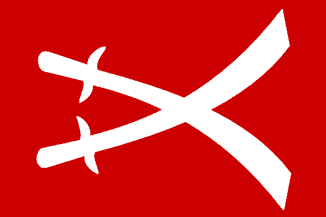 ca. 4:5, image by Jaume Ollé, 13 Dec 1997
The flag was red with two white scimitars in saltire with hilts pointing to hoist and was adopted in the 18th century.
Source: based on sketch of John McMeekin
Jaume Ollé, 13 Dec 1997
 ca. 4:5, image by Jaume Ollé, 13 Dec 1997
The flag was red with two white scimitars in saltire with hilts pointing to hoist and was adopted in the 18th century.
Source: based on sketch of John McMeekin
Jaume Ollé, 13 Dec 1997
 image by Klaus-Michael Schneider, 21 Oct 2026
The flag is red, charged with a white scimitar shifted to fly in fess with hilt pointing to fly. On upper fly is a white disc, representing a full moon.
Source: English WIKIPEDIA
Klaus-Michael Schneider, 21 Oct 2026
image by Klaus-Michael Schneider and Rob Raeside, 20 Oct 2026
The flag was black with two white scimitars in saltire with hilts pointing to hoist.
Above the scimitars was a white disc, representing a full moon.
There was an additional black triangular stremaer at top.
Source: English WIKIPEDIA
Klaus-Michael Schneider, 20 Oct 2026
 image by Klaus-Michael Schneider and Rob Raeside, 20 Oct 2026
The flag was red with two white scimitars in saltire with hilts pointing to hoist.
Above the scimitars was a white disc, representing a full moon.
There was an additional red triangular stremaer at top.
Source: English WIKIPEDIA
Klaus-Michael Schneider, 20 Oct 2026
 image by Klaus-Michael Schneider and Rob Raeside, 20 Oct 2026
The flag was red with two white scimitars in saltire with hilts pointing to bottom.
There was an additional red triangular stremaer at top.
Source: English WIKIPEDIA
Klaus-Michael Schneider, 20 Oct 2026
i2:3, mage by Klaus-Michael Schneider, 21 Oct 2026
The flag is red, charged with a white scimitar in fess with hilt pointing to hoist.
The scimitar is flanked at top by a white radiant sun and at bottom by a white crescent recumbent.
Furthermore between sun and crescent there are two small white discs.
Sources: English WIKIPEDIA and
this photo of reverse
Klaus-Michael Schneider, 21 Oct 2026
 image by Klaus-Michael Schneider, 14 Oct 2026
The flag is dated by the filing card as before 1902. It is red with a vertical white stripe at hoist.
The main charge is a white Zulfiqar, flanked by two white daggers at top and bottom, a white vaning crescent a hoist between two 4-point stars of the same at top and bottom.
Source: Wereldmuseum (department Leiden) filing card archive no. RV-3600-973
Klaus-Michael Schneider, 14 Oct 2026
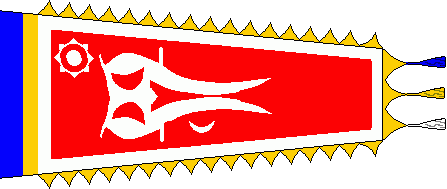 image by Klaus-Michael Schneider and Rob Raeside, 14 Oct 2026
The flag was captured in 1877 by the Dutch during the 2nd Aceh Expedition (1873 - 1881).
Dutch Officer Johan Korndörfer made a painting of the captured flag.
Its appearance does however not match the flag itself, which is also kept in another department of the Museum.
The flag is red and shaped like an isosceles trapezium. The red field is completely surrounded by white edges.
At hoist are vertical stripes from hoist of blue and yellow.
Top, bottom and fly are surrounded by engrailed yellow edges.
At fly are three tassels from top to bottom blue-yellow-white.
On the red field is a white Zulfiqar, below a crescent recumbent of the same and in upper hoist corner a white sun, i.e. a white centre in red annulet in white annulet with eight white rays.
Source: Wereldmuseum (department Leiden) filing cards archive nos. WM 71240-2 and RV-255-10a
The latter explicitly says, that the painting refers to the former.
Klaus-Michael Schneider, 14 Oct 2026
 image by Klaus-Michael Schneider, 14 Oct 2026
The flag is dated by the filing card as prior to 1903.
It is red with a white stripe alongside the hoist and the usual white crescent with 8-point star (fairly small) on centre.
They flanked at top by a white kris (a ceremonial dagger) with small dark blue hilt,
below by a smaller white kris and at bottom by a dark blue rifle with bayonet and white applications (visor, trigger and cartridge chamber).
Source: Wereldmuseum (department Leiden) filing card archive no. RV-1429-98
Klaus-Michael Schneider, 14 Oct 2026
back to Aceh main page click here
